Library of scenarios available in the form of training modules:
Virtual reality training unit for industrial professions: "Virtual Indus" intended for initial and continuing training,
Virtual Indus combines a hardware environment incorporating the latest 3D technologies with training scenarios on the trades/technologies covered in the scenario.
Ideal for acquiring, consolidating, and assessing professional skills.
Integrates the Vulcan environment, a real-time management platform for skills and associated indicators.
Enables the management of learners and educational pathways, the monitoring of results, and integrates with existing digital workspaces and learning management systems. Virtual Indus is supplied with accompanying documents in digital format, including:
Installation and user manuals
Description of virtualized systems integrated into 3D scenes
"Vulcan" training space (management of activities, learners, results, etc.)
General features:
Virtual training module: Production control of the Polyprod Statistical Process Control SPC1 dosing/capping cell (sampling procedure - drift observation - dosing machine adjustment)
Monitor production based on the analysis of indicators, production parameters, and product specifications
Scenario: the packaging company must produce bottles of liquid for a customer. The line operator must ensure that the order complies with the customer's specifications (quantity of product in the bottles).
The training module consists of three sequences:
Sequence 1: Sampling procedure
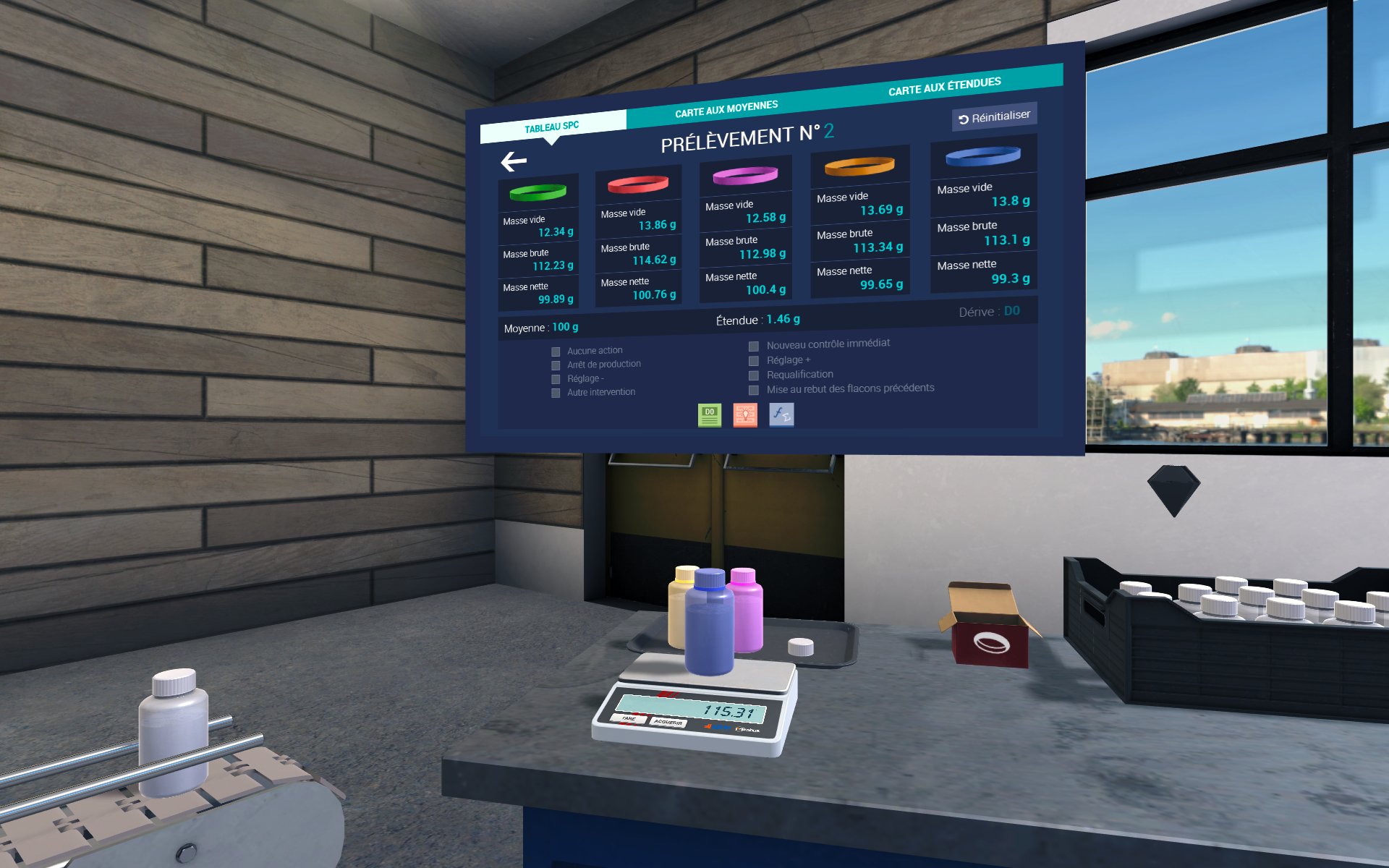
Objectives: Perform a sampling procedure to calculate the average and range of products packaged on the production line, then interpret the results. This procedure uses control charts and graphical representations of results.
Learner activities
Identify the bottles to be sampled during production using rings
Record the weights of the empty bottles using the virtual communicating scale
Start up the Polyprod system and produce bottles with the contents
Collect the identified bottles and weigh them
Record the gross weights on the control charts
Calculate the net weights, the average, and the range
Record the results (mean charts and range charts)
Display the results graphically
Sequence 2: Observing drift
Objectives: Perform statistical checks during production. Observe, qualify, and anticipate indicator results to identify production drift. This activity uses control charts (monitoring limit, control limit, normal zone, enhanced monitoring, and out of control) and the concept of drift.
Learner activities:
Take a sample by applying the sampling procedure. The system records the results on the control charts and automatically calculates the net weights, the mean, and the range.
Identify the sample taken on the graph (average chart).
Determine its zone (normal, enhanced monitoring, out of control).
Code the sample using the deviation table provided.
Repeat the last three steps for the range
Conclude and propose corrective action
Sequence 3: Adjusting the dosing machine
Objectives: Manage the production line by performing statistical checks on control charts to identify any drift. Respond to the defect found and decide whether to adjust the dosing pump using the decision support table. This activity uses control charts, drift, and the decision-making table.
Learner activities
Take a sample by following the sampling procedure.
Observe whether or not there is drift and code it.
Use the decision tree to determine the action to be taken.
Decide on the action to be taken (new dosing device setting).
Calculate the adjustment range.
Set the volume of liquid dispensed on the human/machine console
Record the dispensing pump setting and adjust it
Take a new sample
Validate production (compliant products)
Virtual training module: Production control of the Polyprod Statistical Process Control SPC2 dosing/capping cell (Dosing machine qualification – Control using control charts)
Control a production line using control charts
Scenario: the packaging company produces liquid bottles for a customer. The line operator must ensure that the customer's order complies with the customer's specifications (quantity of product in the bottles).
The training module consists of 2 sequences
Sequence 1: Qualification of the dosing machine
Objectives: Perform statistical checks by sampling in order to monitor significant control indicators, machine parameters, and product parameters. Optimize and qualify settings and validate production. This procedure uses control charts (monitoring limit, control limit, normal zone, enhanced monitoring, and out of control), graphical representations, and drifts.
Learner activities
Take a sample in accordance with the procedure.
Identify the sample taken on the average chart
Determine the zone where the sample is located
Code the sample using the deviation table
Repeat the operation for the range.
Propose and implement a corrective action
Repeat the activity to qualify the dosing pump
Sequence 2: Control using control charts
Objectives: Control the production line using control charts. Adjust production parameters and correct deviations. This activity implements control charts and the concept of defects.
Learner activities:
Take a sample.
Analyze the results using control charts.
Perform a preliminary diagnosis of the cause of the defect.
Estimate the impact on production.
Remedy the issue by proposing a corrective action
Continue to manage the production line
Features of the Vulcan environment:
Virtual Indus integrates the Vulcan environment, either in a local version or a cloud version. This environment allows the trainer to interact with the training course in a spirit of individualization of training.
Management of training courses, classes, groups, learners, training courses, and educational activities.
Real-time monitoring of professional skills development and analysis of results
Recording of the scene for later viewing, enabling analysis of any failures and proposal of objective remedies (knowledge, method, etc.)
Key strengths:
An offer tailored to different needs.
Placing learners in situations in different contexts and original systems that are often difficult to integrate into a training platform.
A virtual experience that is as close to reality as possible (head and hand tracking, virtualized objects, etc.)
A multiplication of learning situations to accelerate the development of professional skills
Practical activities carried out independently with the "right to make mistakes" without risk to the learner or the equipment
Individualized training with monitoring of the learning path (Vulcan training space)
References:
VS10-01-1: Virtual training module: Production management for the Polyprod dosing/capping cell => Statistical Process Control SPC1 (3 educational sequences: Sampling procedure - Observation of drift - Adjustment of the dosing machine) – 1 license
VS10-02-1: Virtual training module: Production control of the Polyprod dosing/capping cell => Statistical Process Control SPC2 (2 teaching sequences: Dosing machine qualification - Control using control charts) – 1 license
 Return to the range "Maintenance & Production Control"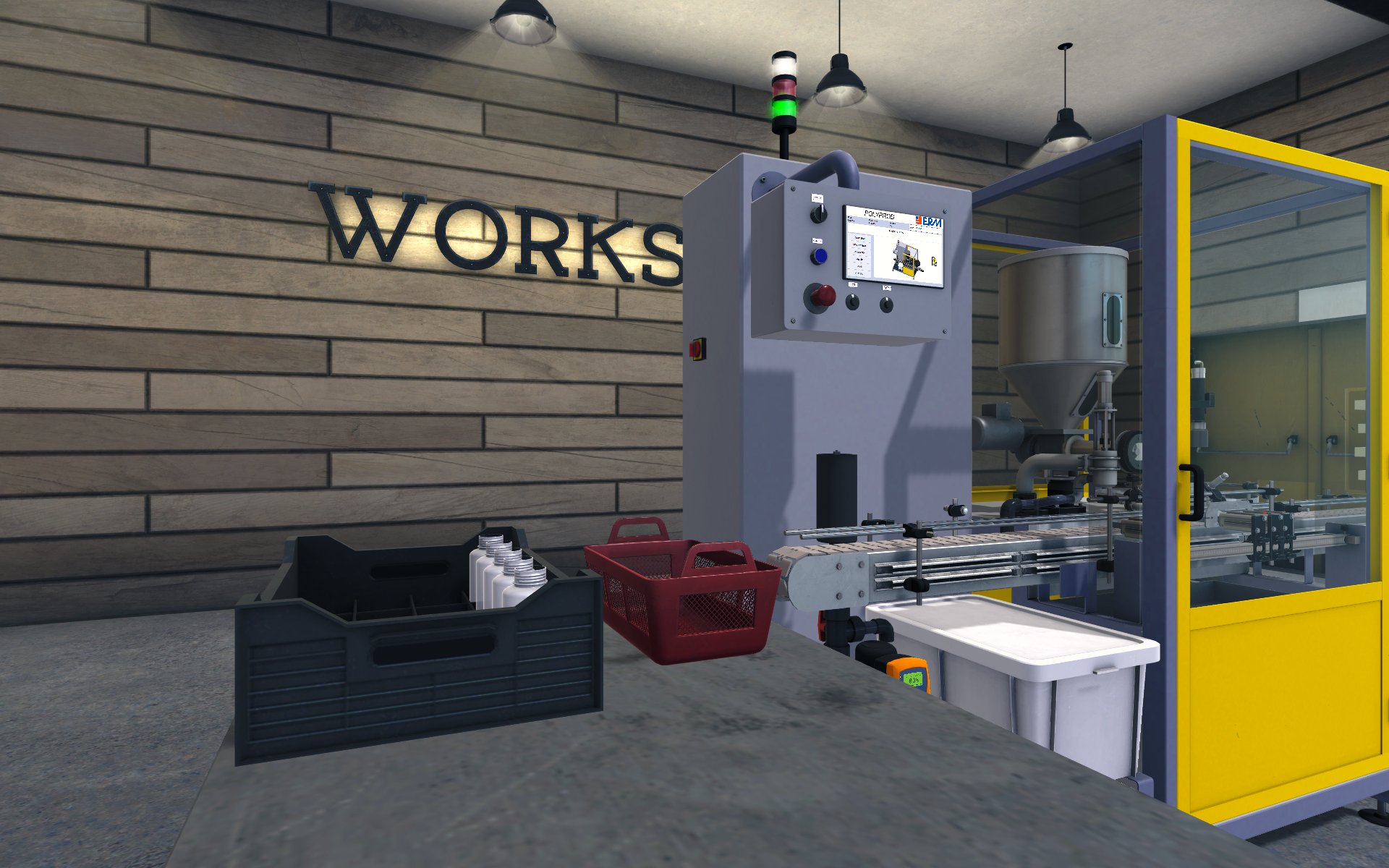
 Virtual Indus "Pilotage de production"
 Supervision statistique en Réalité Virtuelle - VIRTUAL INDUS