 Return to the range "Electrotechnics & Renewable Energy"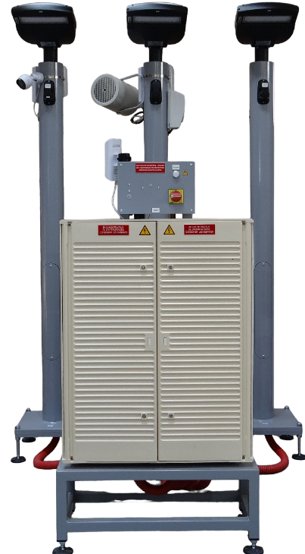
Smart Street Evolution - Connected Public Lighting
Smart digital public lighting system & Digital services platform
 Présentation citypak Tegis
 Plateforme de formation aux SmartGrids et Smart Cities
Related ranges :
Smart digital public lighting system & Digital services platform
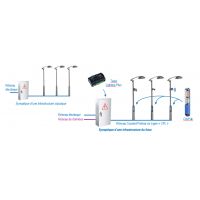
Smart Street Evolution is a connected, educational public lighting system incorporating numerous technological innovations. It is based on real-world installations and implements a street lighting infrastructure that complies with the NF C 14-100 and NF C 17-200 standards.
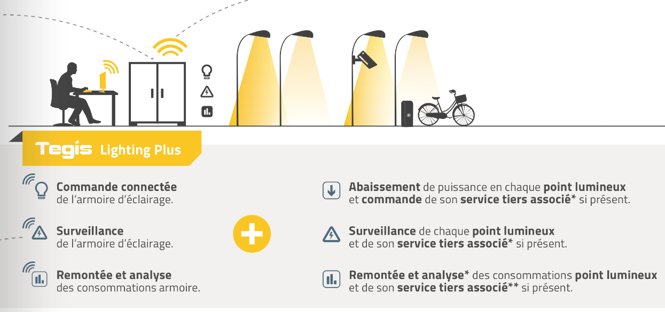
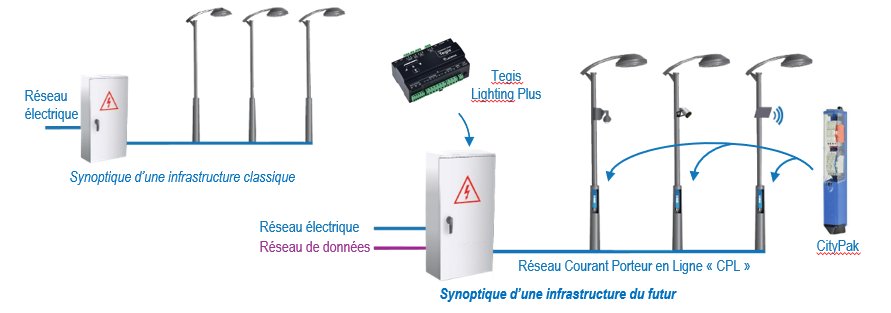
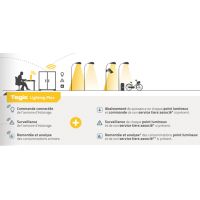
Developed in collaboration with Lacroix City, Smart Street Evolution integrates smart lighting with remote management of the electrical cabinet and remote management at the light point using the Tegis Lighting Plus solution from Lacroix City, enabling it to perform key technical functions:
Smart Street Evolution goes even further and uses public lighting infrastructure to integrate related services:
Smart Street Evolution transforms public lighting into a true electrical and digital platform and responds to the challenges of the Smart City.
This educational system is mainly intended for activities involving implementation, commissioning with adjustments and configurations, operation (real-time control and management) and maintenance.
The system consists of:
The Smart Street system comes with accompanying documents comprising three files (technical, recording and communication media, Health, Safety, and Environmental Protection related to operations) and 9 educational scenarios in Cpro format with detailed instructions and answer keys.
Scenario 1: Discovering the "Connected Public Lighting" system. Students follow a tutorial that guides them through a scenario in which they discover the components of the public lighting system, how it works, and its technological and environmental developments.
Scenario 2: Network connections, NFC 14 100, CIBE, and S17 cabinet control panel. Students learn about the differences between various cabling standards and follow a two-part connection guide. CIBE and control panel.
Scenario 3: Installation and wiring of a "Street and parking lot" type public lighting outlet. Installation and wiring of control and power circuits in the S17 control cabinet.
Scenario 4: Installation, connection, and wiring of electrical equipment for a streetlight. Connection and equipment of the "streetlight base box" protection box, the Citypak Tegis and the LED lighting with DALI control.
Scenario 5: Installation and wiring of the "security and management" circuits of the S17 control cabinet. Wiring of auxiliary circuits as well as heating and lighting management circuits of the S17 cabinet
Scenario 6: Installation and connection of the copper communication link for the S17 cabinet. Students work with Ethernet and fiber network media and communication supports.
Scenario 7: Installation and connection of lighting controller. Installation of the Tegis Control Unit and connection of inputs and outputs.
Scenario 8: Delivery of a "Street" type EP installation Guided configuration allows students to commission the system while performing electrical checks related to the safety, operation, and compliance of the street-type public lighting system.
Scenario 9: Delivery of a "Parking" type public lighting installation. Guided configuration allows students to commission the system while performing electrical checks related to the safety, operation, and compliance of the parking lot-type public lighting system.
Teaching system based on a real industrial solution with thousands of light points equipped with CityPak from Lacroix City.
Teaching activities provided in the form of Cpro scenarios (Cerise Pro) Bac Pro MELEC / Bac Pro CIEL with answers
A single installation to optimize the energy performance of public lighting and deploy future services in a Smart City (mobile Wi-Fi, sound systems, video surveillance, charging stations, environmental sensors, etc.)
CY30: Smart Street Evolution – Connected public lighting
CY31: Second wiring panel (control/command section) kit
CY32: Wiring kit for 1 pole
CY16: IP speaker option on Smart Street
CY17: IP video surveillance camera option on Smart Street
CY19: Fiber optic network connection option
CY35: Additional streetlight option
CY22: Fiber optic infrastructure option, with passive street cabinet (must be launched with CY19)
CY33 : 5-AP Urban Mesh Wi-Fi Kit
SIRMONO-M: Single-phase 3.7/4.6 KW charging point (metal)
SSERVWEB: 10-address web server option for single-phase 3.7/4.6 KW charging point
SGRMONO: Grille and components option for single-phase metal charging station to be wired
Sensicity
SmartCity Webinar
Smart Street Webinar
Smart Grids and Smart Cities Training Platform