 Return to the range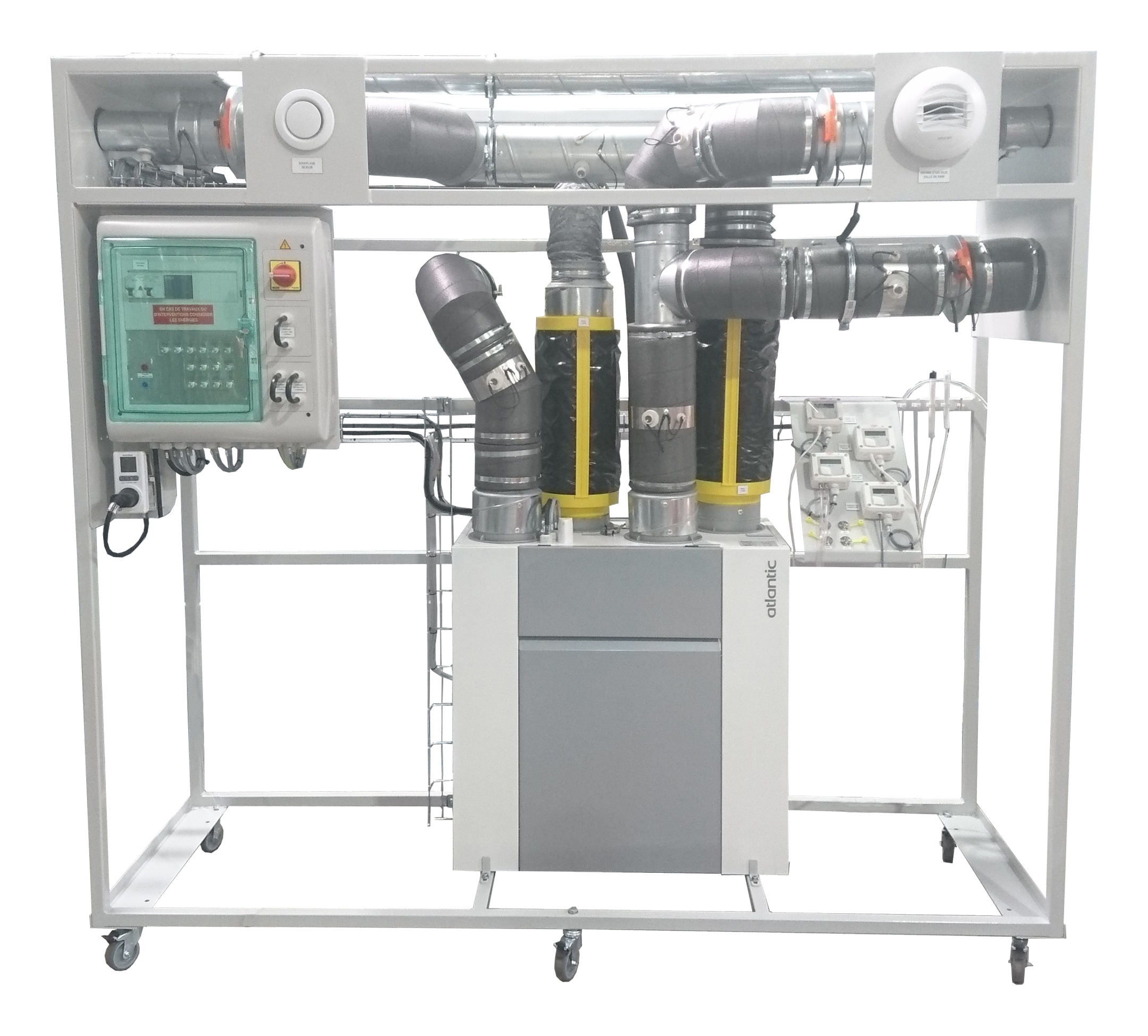
Double Flow Controlled Mechanical Ventilation System & Thermal regulations
Studying a Controlled Mechanical Ventilation system for low energy consumption buildings
Doc. commercial Fr
 VMC Double Flux & Réglementation thermique
Related ranges :
Studying a Controlled Mechanical Ventilation system for low energy consumption buildings
Double Flow CMV (heat exchanger, DC motors, regulation and RF control)
Air flow circuits (pressure loss...)
Data acquisition: temperature, pressure, air flow, hygrometry, rotation speed, power and consumption
Analysis and simulation of performance constraints imposed by thermal regulations
Comparison of mechanical ventilation systems and studying speed variation
Studying mechanical ventilation systems seeking to reach low energy consumption levels
Heat exchangers
Regulation (e.g. Bypass for night-time ventilation)
Studying the impact of ventilation on indoor air quality
Designing and dimensioning ventilation systems for the proposed case studies
Use of the training system for the lab’s ventilation enabling real measurements
Ideal for experiments with heat exchangers
Emphasis on ventilation which is essential in the evolution of thermal solutions for buildings
VM30: Double Flow Ventilation System (VMC) & Thermal Regulation with pressure sensor (x1), airflow rate sensor (x1), humidity sensor (x1), temperature sensors (x4), to be connected to a data acquisition unit.
VM21: Portable instrumentation for acquisition and recording of thermal and airflow operating data.
VM24: Hot or cold air generator for use without an external air intake.
AQ10: USB data acquisition unit.
AQ11: Differential voltage probe for USB data acquisition unit.
AQ12: AC current clamp for USB data acquisition unit