Presentation:
ThermoLab teaching aid, allows the temperature to be set from 40°C to 100°C in 5°C increments.
Maintains the set temperature for approximately 20 minutes as long as it is not removed from its base.
In order to obtain an accurate temperature value, the system is regulated (closed-loop operation). This also allows for rapid heating with high power (2000W).
Opens up the field of thermodynamics, from energy conversion to regulation with measurement acquisition/analysis and validation/exploitation of behavioral or multiphysical models derived from the digital twin.
Allows the kettle to be used in its native application in order to investigate its behavior in terms of performance.
Measures important physical quantities: temperature, voltage, and current at the heating element, which can be done with a multimeter or oscilloscope, but also with a microcontroller card (Arduino) connected to a PC. This board also allows control algorithms of increasing difficulty to be created and validated, either directly using Arduino software tools, or in higher-level environments such as Matlab-Simulink, Labview, or even Python.
Technical solutions covered:
Educational and instrumented kettle
- Stainless steel kettle with adjustable temperature mounted on an instrumentation support for secure control and measurement, with integrated microcontroller board. Includes an expansion port for adding an external control for IoT (Internet of Things) projects.
- An expansion card for Wi-Fi or Bluetooth IoT access and for carrying out FabLab-type projects or activities
- A class A PT 100 temperature probe for calibrating the kettle's sensor
Digital support including
- Educational activity proposals in Word format, accompanied by dedicated software applications (Simulink Arduino)
- The digital twin of the product with multiphysics modeling of the system (Matlab/Simulink Simscape models)
- The technical file with SysML description
- The commissioning and user manual
Educational activities:
STI2D
Functional and structural approach to products
- Representation of MEI flows,
- Functional and structural approach to power conversion modulation adaptation chains,
- Functional and structural approach to an information chain Typology of information chains
- Information acquisition and retrieval, Information coding and processing, Structure of a software application
Behavioral approach to products
- Modeling and simulation Simulation software packages, Model configuration, Simulation configuration, Post-processing and analysis of results,
- Energy behavior of products,
- Informational behavior of products Nature and representation of information, Behavior of regulated or servo systems
Product design
- Informational design of products
Constructive solutions
- Power components Converters, adapters, and power modulators
- Information components Sensors, conditioners
- HMI components, Programmable components
- Experiments and testing
Engineering sciences
Analyzing existing products:
- Analyzing the need for a product and its material and functional organization through a process
- Characterize the power and energy required for a product to function,
- Analyze the behavior of a servo system,
- Analyze the results of experiments and simulations,
- Quantify performance gaps between expected, measured, and simulated values,
- Investigate and propose causes for observed performance gaps,
- Validate models established to describe behavior
Model products to predict their performance
- Propose and justify hypotheses or simplifications for modeling purposes,
- Characterize the physical quantities in the inputs/outputs of a multiphysics model reflecting power transmission,
- Associate a model with the components of a power chain,
- Associate a model with a servo system,
- Use the laws and relationships between force and flow quantities to develop a knowledge model,
- Determine the flow and force quantities in an electrical circuit
Validate product performance
- Predict the order of magnitude of the measurement and identify measurement errors,
- Conduct tests safely using a provided experimental protocol, propose and justify an experimental protocol,
- Modify the influential parameters of the control in order to optimize the performance of the product,
- Implement a numerical simulation based on a multi-physical model to qualify and quantify the performance of a real object,
- Validate a numerical model of the simulated object
Gather information, make choices, and produce information for communication purposes
- Present a protocol, approach, or solution in response to a need,
- Report results
Reference:
STHERMO: ThermoLab, temperature-controlled electric kettle
 Return to the range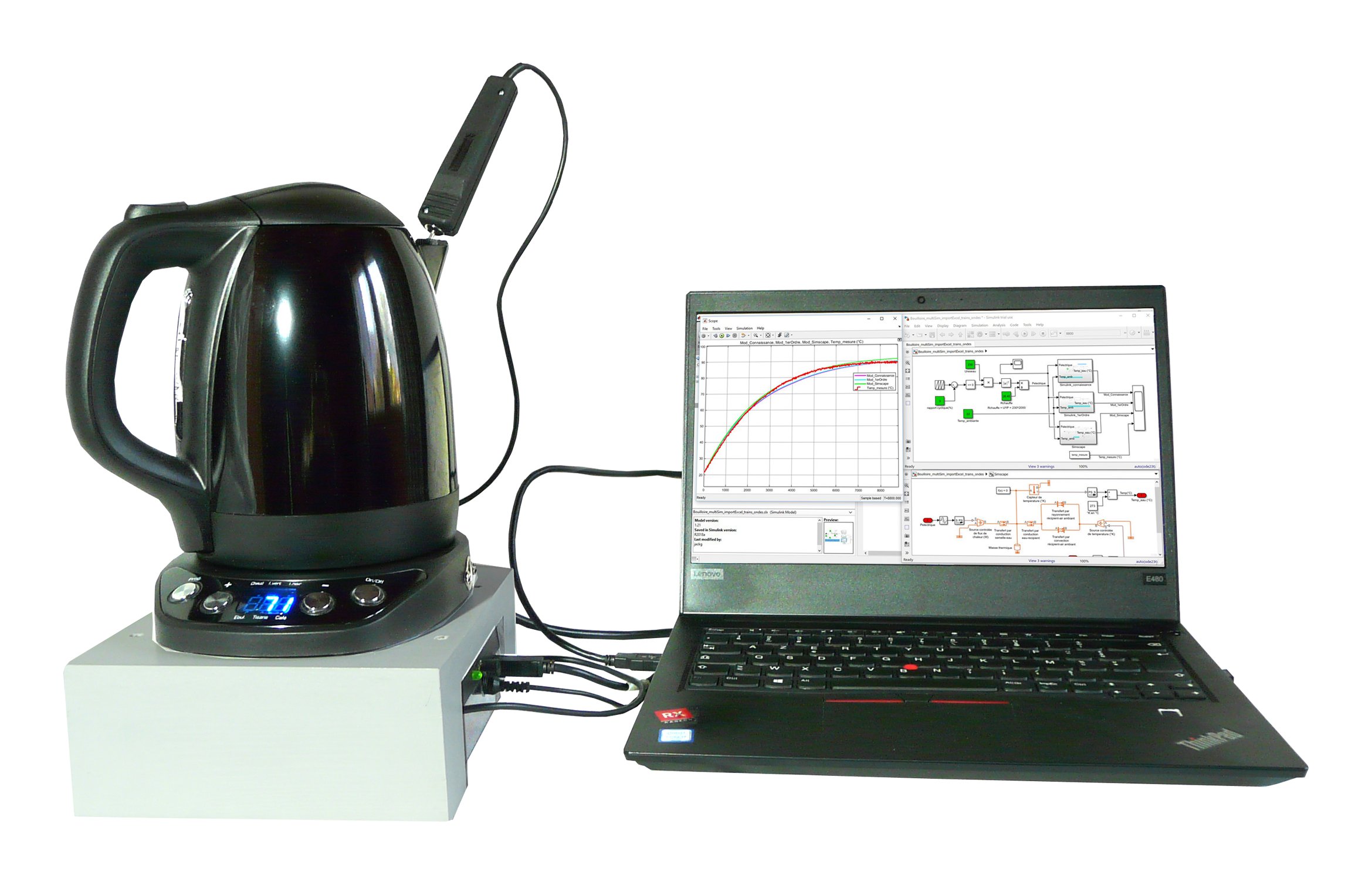
 ThermoLab